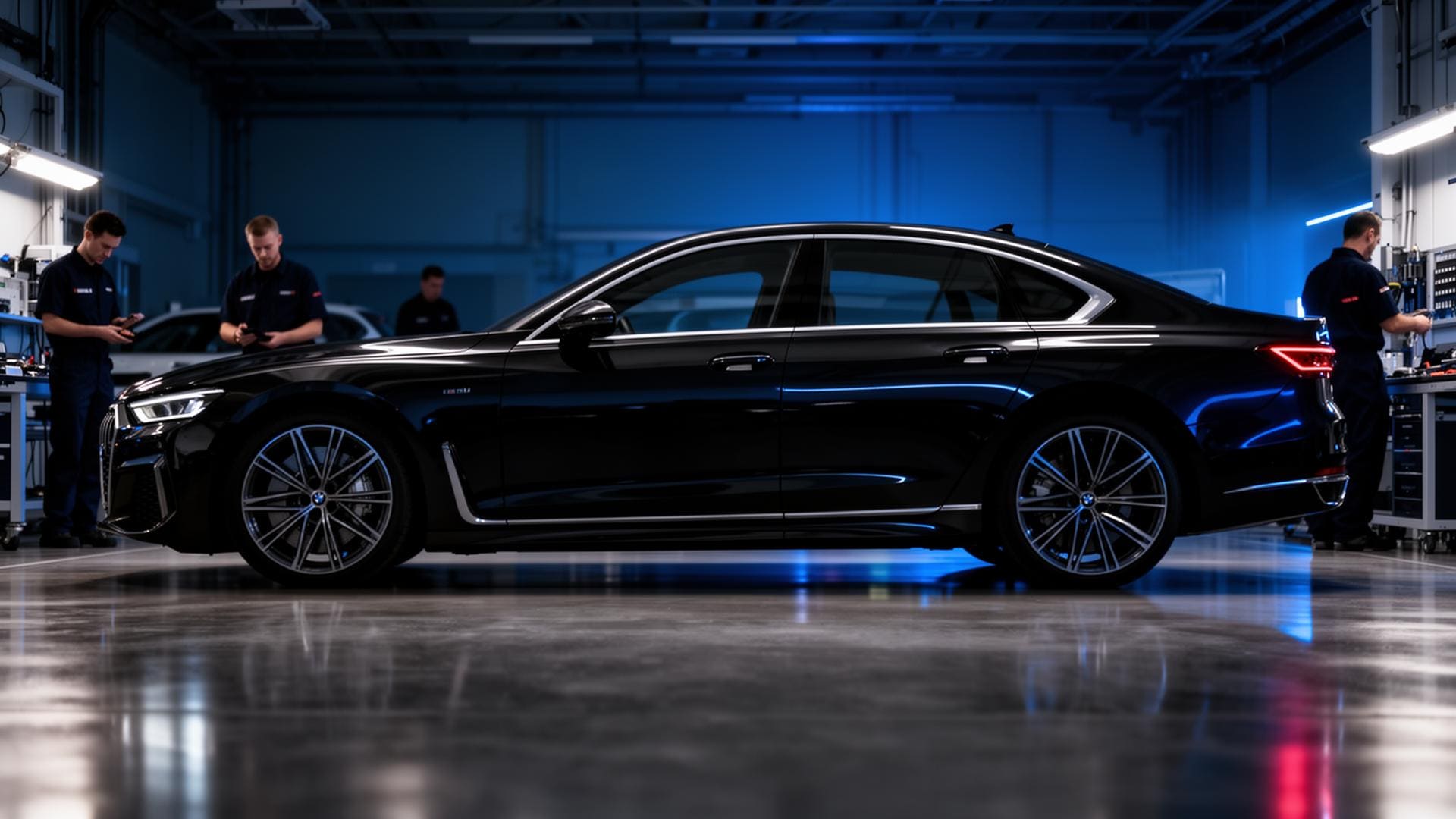
Our Process
15 stages. 60 checkpoints. An automotive engineering laboratory.
Years of experience have taught us that quality cannot be improvised. Our process is born from a deep knowledge of mechanics and electronics, from the analysis of wear patterns and from mastery of preventive and predictive maintenance techniques.
We measure the chemical and physical characteristics of every element and decide based on the data, with immediate and lasting quality as our only priority.
15 stages. 60 checkpoints. We anticipate what could break. Not a dealership — an automotive engineering laboratory.
- 01
Vehicle Selection
We select vehicles at auctions in Europe and on the international market, categorically excluding: serious structural damage, flood damage or engine damage. Every vehicle is checked on Carfax + AutoCheck before we bid. The original video of any auction damage is included in every listing.
Selection is 70% of the result. The wrong vehicle cannot be turned into a good product. Our exclusion criteria are non-negotiable.
Carfax + AutoCheck
- 02
Purchase and Logistics
We verify every document: title of ownership, accident history, compliance with European regulations. We handle the entire import process — customs, type-approval, registration — making sure every step is in order. If a vehicle fails the document checks, it is not purchased.
A car with irregular paperwork can turn into a bureaucratic nightmare. We eliminate this risk at the root, completing every check before purchase.
Document verification + full import process
- 03
Vehicle Arrival: initial inspection and ISR
On arrival the car is inspected in detail, its chemical and physical parameters are measured, and a start-up test and in-depth diagnosis are carried out. The technicians perform a short road test and fill in the Initial Status Report. A specific work plan follows for each vehicle.
Nothing is left to chance. Nothing should break or cause problems for years: that is the target.
Multi-brand diagnosis + road test
- 04
Engine, Gearbox and Differential Oil Analysis
Dielectric analysis of the engine oil confirms the wear condition of ferromagnetic components, from the timing chain to the valves. The same applies to the gearbox and differential: we analyze their fluids to detect contamination, abnormal wear and thermal degradation.
An oil lacking PAO bases or an adequate additive package is not just 'less performant' — it is harmful over the long term. Changing the oil is not enough: you have to know what you are using and why.
Dielectric test + opacimeter
- 05
Braking System Analysis
Measuring disc thickness with a micrometer and checking the residual wear of the pads. Inspection for cracks, grooves and overheating (bluish discoloration). Any component that does not meet our standards is replaced.
Pads and discs work as a pair: ignoring one compromises the entire system. Stopping distance can increase by up to 40% with degraded components.
Micrometer + digital caliper
- 06
Antifreeze / Coolant System
Density test with a floating-ball hydrometer (minimum protection -35°C). pH test for internal corrosion. Radiator inspection for micro-cracks. Cooling circuit pressure test. Thermostat check with an infrared thermometer.
A compromised cooling circuit can lead to overheating and catastrophic engine damage within just a few minutes of driving.
Hydrometer + digital pressure gauge + IR
- 07
Battery Test
Professional tester: measured vs rated CCA, cell condition, % charge. Alternator test under load and at idle. Overnight leakage test (parasitic current draw).
A weak battery masks electrical problems. Overnight leaks indicate faulty modules that stay active.
Midtronics / CTEK
- 08
Brake Fluid
Brake fluid moisture tester (% water). Above 2.5% → mandatory replacement. Visual inspection of calipers, discs, pads.
Brake fluid is hygroscopic: over time it absorbs moisture and loses its incompressibility. The pedal becomes spongy and braking distance grows.
DOT moisture tester + digital caliper
- 09
Braking System (Test Bench)
Checking disc, pad, line and fitting thickness. Braking efficiency test on the test bench: front/rear axle braking balance.
The brakes are the primary safety system. We check every component and replace anything that does not meet our standards.
Braking test bench
- 10
Head Gasket Test
Combustion gas test in the coolant (combustion leak tester). 4-gas exhaust analysis. Cylinder pressure check (max 10% variation). Intake vacuum test.
The head gasket is the boundary between oil, coolant and the combustion chamber. A failure can mean rebuilding the engine: we check it BEFOREHAND with 4 tests.
Combustion leak tester + compression gauge
- 11
Endoscopic Camera Pistons & EGR
Visual inspection of the combustion chamber, cylinder by cylinder. Piston check (scoring, carbon deposits, rings). EGR and duct cleaning with before/after photo documentation. Turbo inspection.
Endoscopy is the engine's CT scan. We see what no scanner can detect.
7mm HD endoscopic camera
- 12
Electronic Diagnostics
Professional OBD2 scanner with error-code reading on ALL modules (not just the engine). Reset after repair with verification that no fault recurs. Results printed in the dossier.
A modern vehicle has 30-80 control units. Reading only the engine module means ignoring 90% of potential problems.
Launch X431 / Autel MaxiSys
- 13
Bodywork & Painting
Paint meter on every panel. Panel straightening with a control bench. Painting in a professional booth with UV-curing.
Bodywork is not just aesthetics — it is the vehicle's protection. A professional paint job lasts 10+ years.
Digital thickness gauge + UV-curing booth
- 14
Tyres and Alignment
Tread depth (minimum 4mm guaranteed). Irregular wear check. Full alignment: toe, camber, caster. Dynamic balancing.
Tyres are the only point of contact between vehicle and road. Incorrect alignment compromises stability, braking and fuel consumption.
3D alignment bench + depth gauge
- 15
Final Work Report Dossier
Branded PDF: before/after photos of every operation, numerical results of every test, list of replaced parts with brand and batch, mechanic's signature, QR code for online verification.
The Dossier is our signature on every vehicle. Every test performed, every result documented, every operation traceable.
Proprietary documentation system
Engine
Compression, leaks, noise and running parameters under load.
Gearbox / Transmission
Engagement, slipping, fluid condition and shift behavior.
Braking system
Discs, pads, calipers and braking efficiency on each axle.
Electronics / ECUs
Full diagnostics, fault codes and verification of every ECU.
Tires and alignment
Wear, pressure, balancing and wheel alignment on the dedicated rig.
Fluids and lubricants
Oil, coolant, brake and steering fluid: level, quality and replacement.
Certified. Guaranteed. Yours.
Every vehicle that passes our process receives the complete Work Report Dossier, AutoLab certification and a warranty that protects your investment. No surprises — only peace of mind.
See the certified vehicles